
If you work in healthcare, you already know that the U.S. medical system runs on a complex, often bewildering maze of billing codes, insurance claims, and government reimbursements. Whether you are a floor nurse, a billing specialist, a practice manager, or a physician, your day-to-day focus is on patient care and operational efficiency.
But every so often, something crosses your desk that makes your stomach drop.
Maybe you notice routine evaluations consistently billed as complex, high-level emergencies. Maybe you see claims submitted for diagnostic tests that patients never actually received or needed. Or perhaps management is quietly instructing clinicians to order specific, expensive durable medical equipment solely to boost practice revenue.
Discovering potential Medicare fraud is a lonely, stressful experience. You care about protecting patients and taxpayer funds, but you also have bills to pay, a career to protect, and a natural fear of workplace retaliation.
This guide is designed to give you clarity. We will walk through what constitutes actionable fraud, how your legal protections work under federal law, and the exact steps you should take to report suspected Medicare fraud safely and effectively.
1. Recognizing the Red Flags: Fraud vs. Clerical Error
Action should only be taken after differentiating between accidental errors and fraud. The CMS processes hundreds of millions of claims each year, and there are always going to be accidental errors and typos that occur each and every day.
Federal healthcare fraud, by contrast, involves knowingly submitting false claims or willfully acting with reckless disregard for the truth to obtain unauthorized payment.
Common Fraud Schemes Seen by Healthcare Workers
- Upcoding and Unbundling: Billing for a higher-complexity procedure than what was actually performed (e.g., billing a Level 5 office visit for a simple prescription refill), or billing separately for procedures that should be bundled together under a single comprehensive code.
- Phantom Billing: Submitting claims for procedures, lab tests, medical equipment, or prescription refills that were never ordered, performed, or delivered to the patient.
- Medically Unnecessary Services: Falsifying patient diagnoses or exaggerating symptoms to justify ordering expensive diagnostic imaging, surgeries, or home health services that the patient does not clinically need.
- Kickbacks and Improper Referrals: Involving oneself in an activity that violates the anti-kickback statute or the Stark law, whereby money incentives are provided as part of the referral process involving Medicare beneficiaries to certain specialists or testing centers.
Note for Healthcare Staff: You do not need to be an expert in federal billing laws to recognize when a pattern of behavior is systematically dishonest. If leadership repeatedly ignores internal warnings about improper billing practices, you are likely looking at intentional fraud rather than a simple oversight.
2. The Internal Dilemma: Fear of Retaliation

Let’s be completely candid: blowing the whistle on your employer is intimidating. The immediate fear for most healthcare workers is getting fired, demoted, harassed, or blacklisted within the local medical community.
Historically, these fears kept countless healthcare professionals silent. On the other hand, federal law acknowledges that the government will not be able to detect the more complex and hidden cases of healthcare billing fraud without the whistleblowers stepping forth. This is why the government has put in place very strong protections for these individuals.
3. Your Armor: The False Claims Act and Qui Tam Protections
The foundational federal law governing Medicare fraud is the False Claims Act (FCA). Originally enacted during the Civil War to combat defense contractor fraud, the FCA has evolved into the government’s premier tool for prosecuting healthcare fraud.
How Qui Tam Lawsuits Work
Under the qui tam (whistleblower) provisions of the False Claims Act, private citizens who possess independent, inside knowledge of fraud against the government can file a lawsuit on behalf of the United States.
If the lawsuit results in the recovery of stolen government funds, whether through a trial verdict or a negotiated settlement, the whistleblower is legally entitled to a financial reward ranging from 15% to 30% of the total amount recovered. In major Medicare fraud schemes involving millions of dollars, these awards can be life-changing, serving as tangible recognition of the risk the whistleblower took to expose the wrongdoing.
Powerful Anti-Retaliation Protections
The provision of 3730(h) of the False Claims Act prevents retaliation by the employer against whistleblowers. If you have been terminated, threatened, harassed, demoted, or had your salary cut because of your investigation, complaining or whistleblowing on fraud in billing, then under federal law, you are entitled to:
- Reinstatement with your previous seniority level intact.
- Double back pay plus interest for all lost income.
- Compensation for certain damages, including emotional distress and litigation costs.
- Mandatory payment of your attorney’s fees by the retaliating employer.
4. How to Report Medicare Fraud Safely: Step-by-Step
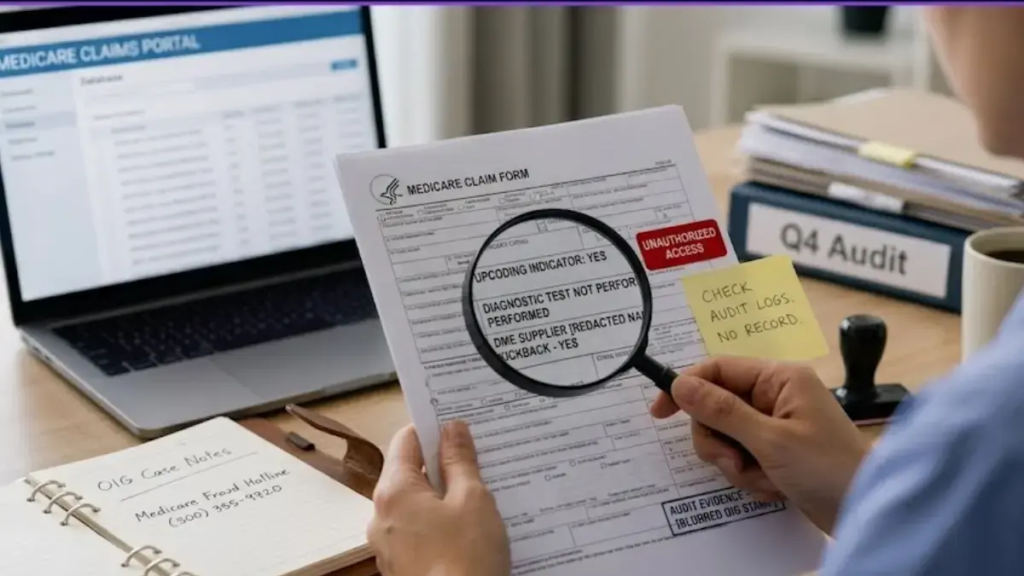
If you have resolved to take that step, then proper execution will be everything. There are chances that the process can hamper the government’s investigation, reveal your identity, or lead to a violation of privacy laws. Here is what you need to do in order.
Step 1: Document the Evidence Carefully
Memories by themselves are generally not sufficient to make a case against fraud at the federal level. There needs to be some physical documentation that proves that fraud has occurred.
- What should be collected: Information on billing codes, billing summaries, email communications asking employees to modify documentation, dates of services, and NPI numbers.
- The HIPAA boundary: Take great care when it comes to the confidentiality of your patients. You mustn’t download, email or even print any patient files if you are not authorized to access those within the context of your work-related responsibilities. If you illegally possess those files, then you may end up getting yourself into serious legal trouble. Get all the files that you are authorized to access and take some notes in your personal notebook.
Step 2: Speak with a Healthcare Fraud Attorney Immediately
Before you call a federal hotline or confront human resources, it is best to first call an experienced healthcare fraud attorney.
Many healthcare workers mistakenly believe their best move is to call the Department of Health and Human Services Office of Inspector General hotline directly. Although the OIG hotline could help with small tips, the use of a public hotline does not start a qui tam case under the False Claims Act. In the event that one reports through a hotline without an attorney, they may forfeit their right to receive compensation as a whistleblower, since the proper way to be compensated is through a qui tam action.
The lawyer will review your evidence under attorney-client privilege, will evaluate whether your case may be viable in court, and will show you how to document your case further without violating HIPAA.
Step 3: File the Complaint Under Seal
When your attorney files a qui tam lawsuit under the False Claims Act, it is filed under seal in federal court.
“Under seal” means the lawsuit is entirely confidential. The public cannot see it, your coworkers cannot see it, and, most importantly—your employer is not notified that a lawsuit exists. The seal must generally last for a period of at least 60 days (or even longer periods lasting for months and even years). The purpose of this seal is to guarantee that your identity and your job will remain secret as the government investigates in a manner that is completely confidential.
Step 4: Government Review and Intervention
Once federal investigators (from the Department of Justice and the HHS-OIG) analyze the evidence submitted by your attorney, they decide whether to intervene (take over and lead the prosecution of the lawsuit).
- If the government intervenes, they throw the full investigative and legal weight of the United States government behind your case. Historically, cases where the DOJ intervenes result in favorable settlements or verdicts the vast majority of the time.
- If the government declines, you and your attorney still maintain the legal right to pursue the lawsuit independently on behalf of the government, often with a higher potential reward percentage (up to 30%).
5. Direct Reporting vs. Filing a Qui Tam Lawsuit
To clarify the structural differences between your reporting avenues, compare the two primary paths below:
| Feature | HHS-OIG Public Hotline | Qui Tam Lawsuit via Attorney |
| Primary Mechanism | Online form or phone call to agency | Formal federal lawsuit filed under seal |
| Anonymity | Can request anonymity, but harder to track | Identity protected under federal court seal initially |
| Financial Reward | Generally No (Hotline tips lack FCA reward standing) | Yes (Entitled by law to 15%–30% of recovery) |
| Legal Representation | None (You are an informant acting alone) | Dedicated legal counsel protecting your rights |
| Retaliation Shield | General whistleblower protections apply | Strong, enforceable remedies (double back pay, legal fees) |
Final Thoughts: Doing the Right Thing with the Right Support

Medical practitioners choose to join the healthcare industry in order to help people rather than be a part of a scheme that robs patients and taxpayers. Every cent taken out of Medicare due to overbilling or any other illegal activity means that money has been stolen from the sick and the elderly.
Taking a stand takes courage, but you needn’t undertake the journey without direction. With the knowledge of the law, respect for data privacy restrictions, and support from a seasoned legal team, you will be able to responsibly report your billing fraud claims while preserving your professional integrity and earning all the legal rights that you deserve.
Communication of information by, in, to or through this website and your receipt or use of it:
- is not provided in the course of and does not create or constitute an attorney-client relationship,
- is not intended as a solicitation,
- is not intended to convey or constitute legal advice, and
- is not a substitute for obtaining legal advice from a qualified attorney.
You should not act upon any such information without first seeking qualified professional counsel on your specific matter. The hiring of an attorney is an important decision that should not be based solely upon Web site communications or advertisements.