
According to the federal False Claims Act (FCA), whistleblowers filing successful qui tam actions are eligible for 15% to 30% of the money recovered by the government. The money recovered under the FCA includes treble damages, which means that the total amount may be considerable. If the Department of Justice (DOJ) intervenes and leads the lawsuit, the whistleblower receives between 15% and 25%. If the government declines to intervene and the whistleblower prosecutes the case independently with their own legal team, the statutory reward increases to between 25% and 30%. Since 1986, U.S. whistleblowers have been awarded over $9 billion for exposing fraud against taxpayers.
Why the False Claims Act Is America’s Most Powerful Anti-Fraud Law
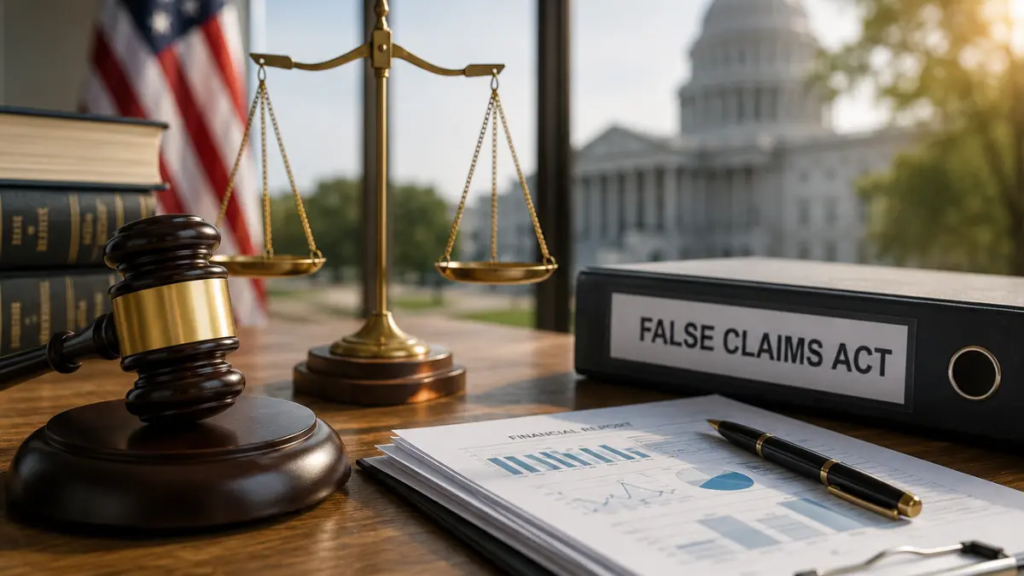
When corporations or individuals defraud U.S. government programs—whether through Medicare billing schemes, defense contracting fraud, or dodging customs duties—taxpayers foot the bill. To fight back against this waste, the federal government relies heavily on insiders willing to speak up. But blowing the whistle takes immense courage. It can threaten your career, your personal relationships, and your financial stability.
To incentivize citizens to step forward and protect them from financial ruin, Congress strengthened the False Claims Act (FCA) in 1986. The law features a unique mechanism known as the qui tam provision. Under this provision, private citizens—referred to in court as relators—can file a lawsuit on behalf of the federal government against the wrongdoers.
In exchange for taking on that risk, the government shares a significant slice of the recovered funds with the whistleblower. But how much money does that actually translate to in practice, and how is the final number decided?
The Statutory Reward Breakdown: 15% to 30%
The percentage of the total recovery you receive as a whistleblower depends primarily on one foundational question: Did the government intervene in your case?
When you file a qui tam lawsuit, it is placed under seal (kept strictly confidential) in federal court while the Department of Justice investigates your allegations. At the end of this investigation, the DOJ makes a pivotal decision:
- Government Intervenes (15% – 25% Reward): If the DOJ sees strong evidence of fraud, it will “intervene” and take over the primary prosecution of the lawsuit. This happens in a minority of filed cases, but it drastically increases the likelihood of a significant recovery. In these cases, the whistleblower is entitled to a reward of between 15% and 25% of the final settlement or court judgment.
- Government Declines to Intervene (25% – 30% Reward): For many reasons, the DOJ can decide not to intervene. The decision not to intervene is not always based on the merits of the lawsuit. Sometimes, the DOJ lacks the government resources to pursue a case, or it decides not to intervene for logistical reasons. When this happens, you have the legal right to proceed with the lawsuit independently using your own private whistleblower attorneys. Because you and your legal team are shoulder-to-shoulder bearing the entire burden, risk, and expense of litigation, the law increases your reward share to between 25% and 30% of the proceeds.
Why FCA Payouts Can Be Massive: Treble Damages and Civil Penalties

To understand why 15% to 30% can equate to multi-million-dollar rewards, you have to look at how the government calculates the “total recovery”. You are not merely receiving a percentage of the amount the company defrauded the government out of; you are receiving a percentage of the penalties the government enforces.
Under the False Claims Act, defendants who knowingly defraud the government face two distinct layers of financial liability:
- Treble Damages: The court is authorized to multiply the government’s actual financial losses by three. If a pharmaceutical company overcharged Medicaid by $10 million, the statutory liability automatically jumps to $30 million.
- Mandatory Per-Claim Civil Penalties: In addition to treble damages, the law assesses a steep, mandatory civil fine for every single false invoice, claim, or prescription submitted. Because these fines are adjusted annually for inflation, the penalty range stands at $14,308 to $28,619 per false claim.
A Real-World Calculation Example
Imagine a medical device distributor submits 10,000 fraudulent invoices to Medicare over four years, causing $15 million in actual losses to the government. Here is how the total liability and potential whistleblower reward break down:
| Component | Calculation | Amount |
| Actual Fraud Loss | Direct government loss | $15,000,000 |
| Treble Damages (3x) | Statutory multiplier applied to loss | $45,000,000 |
| Civil Penalties | 10,000 claims × $14,308 (minimum penalty) | $143,080,000 |
| Total Defendant Exposure | Treble damages + minimum civil penalties | $188,080,000 |
| Whistleblower Reward (20%) | Mid-range award on an intervened case | $37,616,000 |
As this scenario shows, even modest fraud schemes can balloon into nine-figure liabilities when thousands of individual claims are involved, leading to life-changing awards for the relator.
What Determines Your Exact Share on the Sliding Scale?
Whether the government awards you 15% at the bottom of the scale or pushes you up toward the 25% or 30% ceiling depends entirely on the unique facts of your case.
Factors That Increase Your Reward Share
- Prompt Reporting: The sooner you report the fraud after discovering it, the higher your award. Rapid reporting stops ongoing taxpayer losses and helps prosecutors secure critical evidence before it is destroyed.
- High-Quality, Original Information: Providing concrete documentation – such as internal emails, billing spreadsheets, or recorded memos – is far more valuable than general suspicion. Your information must be “original,” meaning it is not already known to the public or the DOJ.
- Active Assistance: Relators who actively cooperate with federal investigators – helping explain complex industry jargon, reviewing financial documents, and testifying at depositions – earn a larger slice of the pie.
- Standing Alone: Being the sole source of the investigation and the first to file (known as the FCA’s strict first-to-file rule) is mandatory to secure your claim.
Factors That Decrease Your Reward Share
- Delay in Reporting: Sitting on evidence for years while the fraud continues can result in a reduced percentage.
- Complicity in the Fraud: Should you have played any role in planning, initiating, and leading the fraud scheme, the government can drastically reduce your percentage. However, following unlawful orders from your superior under pressure generally is not a reason for decreasing the reward.
- Public Disclosures: If your lawsuit is based on information already reported in the news media, congressional hearings, or public audits, your share can be capped at 10% or less, or your case may be dismissed entirely unless you qualify as an “original source”.
By the Numbers: Record-Breaking Whistleblower Statistics
The sheer amount of money collected under the False Claims Act shows how well the system works to encourage reporting. The latest government statistics make clear why the FCA is the gemstone of all federal investigations:
- $85+ Billion Total Recoveries: Since the statute was modernized in 1986, federal FCA settlements and judgments have surpassed $85 billion.
- $61+ Billion from Whistleblowers: Over $61 billion of that all-time total—roughly 70%—came directly from qui tam lawsuits initiated by everyday citizens.
- $9+ Billion Paid to Relators: Whistleblowers have earned more than $9 billion in rewards for their assistance over the past four decades.
- FY 2025 Historic Highs: In Fiscal Year 2025 alone, the DOJ recovered a record-shattering $6.8 billion under the FCA. Over $5.3 billion of that annual haul was generated by whistleblower actions, with relators filing a record 1,297 new qui tam lawsuits in a single year.
- Healthcare Domination: Healthcare fraud—involving Medicare, Medicaid, pharmaceutical kickbacks, and unnecessary medical procedures—consistently accounts for over 80% of all FCA recoveries ($5.7 billion in FY 2025 alone). Defense contractor fraud and customs duty evasion make up the remaining balance.
The Roadmap: How Long Does It Take to Get Paid?
There are a number of misconceptions surrounding whistleblowers, one of which is that being a whistleblower will bring a quick pay day. In reality, a False Claims Act lawsuit is a process that takes time. It normally takes 3-7 years for a whistleblower to get their reward after initiating the lawsuit because it involves:
- Retaining Counsel & Investigation: You must hire an experienced whistleblower attorney to draft a comprehensive complaint and a formal “Disclosure Statement” detailing your legal theories and all your evidence.
- Filing Under Seal: The lawsuit is filed secretly in federal court. The defendant is not notified, and the public has no access to the record.
- DOJ Investigation (The Seal Period): By statute, the seal lasts 60 days, but federal prosecutors almost always request multiple extensions. The DOJ often spends 1 to 3 years conducting its investigation that can include subpoenaing records, interviewing witnesses, and analyzing billing data behind closed doors.
- The Intervention Decision: The government formally announces whether it will join your case or decline.
- Litigation or Settlement Negotiation: Once the seal is lifted, the complaint is served on the defendant. Most intervened cases result in a settlement within a year of unsealing, while declined cases litigated independently by the whistleblower may proceed to trial over several additional years.
- The Reward Distribution: Once the defendant pays the settlement or judgment into the U.S. Treasury, the DOJ or court distributes your statutory share (15% to 30%), and your legal team receives their statutory attorneys’ fees paid separately by the defendant.
What About Taxes and Employer Retaliation?
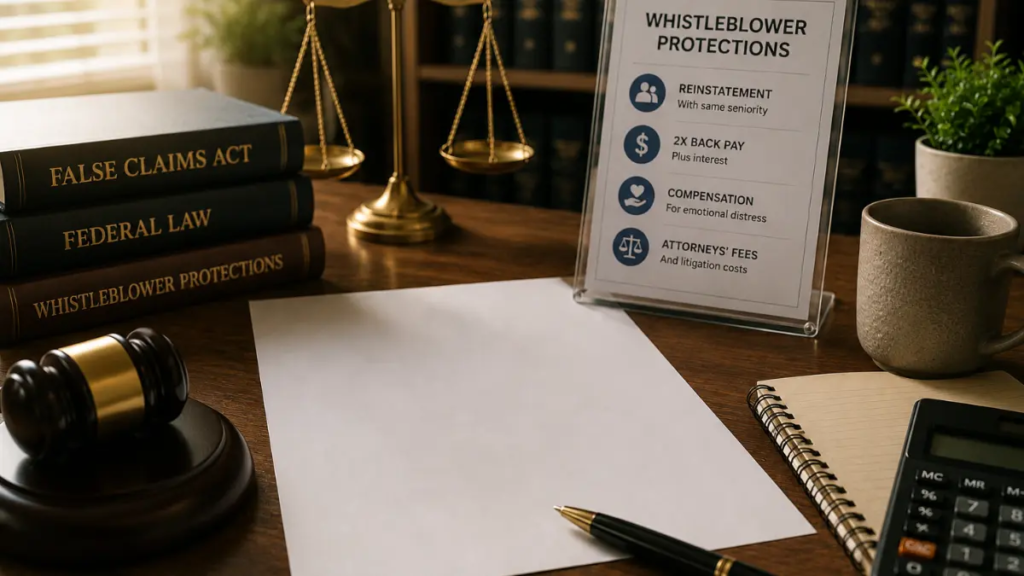
Before taking action, every potential whistleblower must weigh two critical practical considerations: taxes and job security.
Are Whistleblower Rewards Taxable?
Yes. The Internal Revenue Service treats False Claims Act rewards as ordinary income in the year they are received. Because large awards can easily push you into the highest federal tax bracket (37%), robust tax planning is essential. However, under the American Rescue Plan and federal civil rights tax laws, whistleblowers can generally utilize an above-the-line deduction for their attorneys’ fees. This ensures you are only paying taxes on your net financial gain rather than the gross award.
Am I Protected from Employer Retaliation?
Absolutely. Congress recognized that fear of termination is the number-one deterrent to reporting fraud. Under Section 3730(h) of the False Claims Act, there are strong anti-retaliation laws. If your employer dismisses, demotes, suspends, intimidates, or blacklists you for investigating and whistleblowing on False Claims Act violations, then you have the right to sue under these anti-retaliation laws. You can be awarded:
- Reinstatement with the same seniority level you would have had without the discrimination.
- 2x Back Pay (double the wages you lost during the termination or suspension). Interest on the lost back pay.
- Special Damages, including compensation for emotional distress, plus full coverage of your litigation costs and reasonable attorneys’ fees.
Key Takeaways: Protecting Taxpayers and Yourself
Raising red flags on fraudulent practices in corporations is a very serious civic obligation, one that safeguards American taxpayers, health care recipients, and military members from being victimized. This procedure is not only complex but also one that requires a lot of planning and patience.
If you have evidence of fraud against the federal government, keep these core rules in mind:
- Do not go public or confront your boss prematurely. Doing so can destroy valuable evidence and jeopardize your legal standing under the FCA’s strict procedural rules.
- Time is of the essence. The first-to-file rule dictates that only the very first whistleblower to bring allegations to the courthouse door is eligible for the financial reward.
- Seek specialized legal counsel immediately. Qui tam litigation is a highly specialized field. Working with an experienced False Claims Act lawyer means that your evidence will be presented to the Department of Justice most effectively, increasing both the government’s involvement and your financial award.
Communication of information by, in, to or through this website and your receipt or use of it:
- is not provided in the course of and does not create or constitute an attorney-client relationship,
- is not intended as a solicitation,
- is not intended to convey or constitute legal advice, and
- is not a substitute for obtaining legal advice from a qualified attorney.
You should not act upon any such information without first seeking qualified professional counsel on your specific matter. The hiring of an attorney is an important decision that should not be based solely upon Web site communications or advertisements.