
Fraud against the government is not a modern problem.
Long before healthcare billing systems, government databases, Medicare claims, or billion-dollar federal contracts existed, the United States was already dealing with contractors who tried to profit by supplying the government with defective goods and submitting questionable claims for payment.
During the American Civil War, this problem became serious enough that Congress acted.
The result was the False Claims Act, a federal law enacted in 1863 that remains one of the government’s most important tools for recovering money lost through fraud. Today, the law applies to situations ranging from healthcare and Medicare fraud to defense contracting, government grants, and other federally funded programs.
What sets the False Claims Act apart from other legislation is that the act does not solely depend on the investigation done by government agencies. This is because of the qui tam aspect of the act, which gives an opportunity for a private party to sue the U.S. and get a portion of the money recovered.
To understand why the law works this way, it helps to look at how it began.
The Civil War Origins of the False Claims Act
The False Claims Act was passed in 1863 during President Abraham Lincoln’s administration, which is why it is sometimes called the Lincoln Law.
At the time, the federal government was spending enormous amounts of money purchasing supplies for the Union Army.
Unfortunately, some contractors saw the war as an opportunity to make money through fraud.
Historical accounts describe contractors supplying the government with sick or unusable horses and mules, faulty weapons and ammunition, and spoiled military provisions. Congress was concerned that dishonest suppliers were taking taxpayer money while providing products that could be practically useless to soldiers.
This was more than financial misconduct.
When defective equipment or inadequate supplies were delivered during wartime, fraud could potentially place soldiers’ lives at risk.
Congress therefore created a law that allowed the government to pursue people and businesses that knowingly submitted false claims for federal money.
The original law imposed civil and criminal consequences. On the civil side, the government could recover double its damages along with a monetary forfeiture for each false claim.
But Congress included another important feature: ordinary citizens could help expose the fraud.
The Birth of Qui Tam Lawsuits

One of the most distinctive parts of the False Claims Act is its qui tam provision.
The phrase comes from an older legal concept allowing a private individual to pursue a case partly on behalf of the government.
Today, a person who files a False Claims Act qui tam lawsuit is usually called a relator.
Rather than waiting for the government to independently discover every fraudulent billing scheme, the law allows someone with relevant information to bring a lawsuit on behalf of the United States.
This is important because insiders are often in the best position to identify fraud.
An employee working inside a hospital, medical practice, government contractor, pharmacy, laboratory, nursing home, or other organization may see billing practices and internal records that government investigators would otherwise never know existed.
Under the modern False Claims Act, successful whistleblowers may receive a portion of the government’s recovery.
That incentive became increasingly important as the law evolved.
The 1943 Changes to the Law
The False Claims Act did not remain unchanged after the Civil War.
In 1943, Congress significantly modified its qui tam provisions.
One concern involved lawsuits based on information that the federal government already possessed. Congress sought to restrict these so-called “parasitic” lawsuits and gave the government greater authority to take over qui tam cases.
The amendments also reduced the potential share available to whistleblowers.
While the changes addressed perceived abuses, they also made qui tam cases less attractive to potential whistleblowers.
For several decades afterward, the False Claims Act was used less aggressively than it would be later.
That changed dramatically in the 1980s.
The 1986 False Claims Act Amendments
By the early 1980s, concerns about fraud involving federal contracts and programs were again growing.
Congress concluded that the existing False Claims Act was not providing strong enough incentives for insiders to expose wrongdoing.
In 1986, Congress enacted major amendments championed by Senator Charles Grassley and Representative Howard Berman. President Ronald Reagan signed those amendments into law.
The changes transformed the False Claims Act into a much stronger whistleblower enforcement tool.
Among other things, the amendments:
- Strengthened the qui tam provisions.
- Increased incentives for whistleblowers.
- Expanded whistleblower participation in cases.
- Increased potential damages available to the government.
- Improved protections for individuals reporting fraud.
- Gave the government stronger investigative tools.
The government was also permitted to pursue treble damages, meaning potentially three times the amount of damages caused by the fraud.
These reforms fundamentally changed the role of whistleblowers in federal fraud enforcement.
Instead of being peripheral participants, insiders became an important source of information for federal investigators.
How a Modern Qui Tam Case Works

Although the law has become more sophisticated, the central idea behind qui tam remains straightforward.
A whistleblower who possesses information about suspected fraud may work with a False Claims Act attorney to file a lawsuit on behalf of the United States.
Unlike an ordinary civil complaint, the initial qui tam complaint is generally filed under seal.
That means the defendant is not immediately notified.
The complaint and supporting information are provided to the federal government, giving the Department of Justice time to investigate the allegations.
After investigating, the government can decide whether to intervene in the case.
If it intervenes, government attorneys take a leading role in pursuing the claims.
If the government declines to intervene, the whistleblower may, under appropriate circumstances, continue pursuing the action.
A successful relator may receive a percentage of the recovery. DOJ materials describe whistleblower shares that generally can range from 15% to 30%, depending on factors including whether the government intervenes.
From Civil War Contractors to Healthcare Fraud
The type of fraud targeted by the False Claims Act has changed considerably since 1863.
The government is no longer primarily concerned with contractors selling sick mules or defective rifles.
Today, False Claims Act cases can arise in many industries receiving federal money.
Healthcare has become one of the most significant areas.
Potential cases may involve allegations such as:
- Billing Medicare for assistance that were never provided
- Billing for medically unnecessary procedures
- Upcoding medical services
- False certification of eligibility
- Improper healthcare kickbacks
- Fraud involving nursing homes
- Home health billing fraud
- Pharmacy fraud
- Medicaid-related false claims
The law is also used in cases involving defense contracting, government procurement, federal grants, federally insured programs, and other government expenditures.
The setting has changed, but the basic principle remains almost identical to the one Congress confronted during the Civil War:
Someone should not knowingly obtain government money through false or fraudulent claims.
Additional Changes in 2009 and 2010
The False Claims Act continued to evolve after the major 1986 reforms.
In 2009, Congress passed the Fraud Enforcement and Recovery Act, commonly known as FERA.
The legislation made additional changes intended to strengthen and clarify False Claims Act enforcement, particularly after court decisions had narrowed certain aspects of the statute.
Further changes followed in 2010 through the Affordable Care Act.
Those provisions strengthened aspects of whistleblower enforcement and also affected healthcare fraud enforcement, including issues involving the federal Anti-Kickback Statute.
These updates illustrate an important characteristic of the False Claims Act: although the law began in the nineteenth century, Congress has repeatedly modified it to respond to modern forms of fraud.
Why Whistleblowers Remain So Important
Government agencies have investigators, auditors, prosecutors, and sophisticated analytical systems.
But they still cannot see everything happening inside private organizations.
A fraudulent billing practice might be hidden inside thousands of patient files.
A defense contractor may have internal testing records contradicting what it told the government.
A healthcare employee might notice that patients are repeatedly being billed for services they never received.
These insiders can provide something government investigators often lack: context.
They may know who approved the practice, when it started, how records were changed, and where the supporting evidence can be found.
That is one reason qui tam lawsuits remain such an important component of False Claims Act enforcement.
The False Claims Act Today
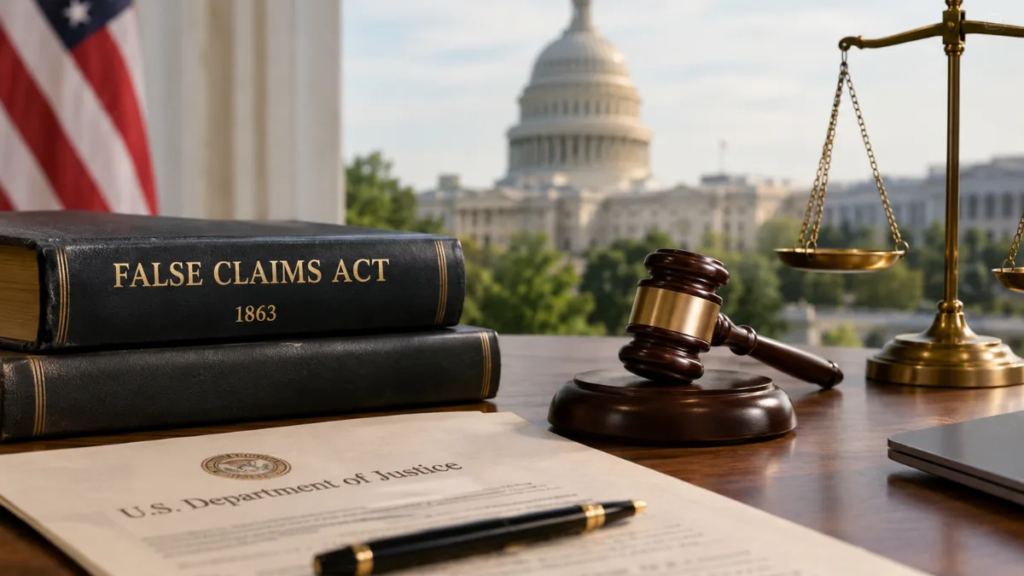
More than 160 years after it was enacted, the False Claims Act continues to play a central role in federal fraud enforcement.
The Department of Justice describes the FCA as applying to people or entities that knowingly submit or cause false claims to be submitted to the government, use false information material to such claims, or improperly avoid financial obligations owed to the government.
The law continues to evolve as government spending and fraud schemes change.
In September 2026, for example, the Department of Justice announced revisions to its enforcement guidance involving False Claims Act cases, illustrating that the government’s approach to FCA enforcement is still developing even today.
Yet the basic mission remains remarkably similar to what Congress intended in 1863: protect taxpayer money and provide mechanisms for exposing fraud against the government.
Final Thoughts
The False Claims Act has survived for more than a century and a half because the problem it addresses has never completely disappeared.
The fraudulent contractor selling unusable military supplies during the Civil War may look very different from a healthcare provider submitting false Medicare claims today, but the underlying conduct is similar: government funds are being obtained through allegedly false or misleading claims.
What makes the False Claims Act particularly powerful is the partnership it creates between the government and private citizens.
By allowing whistleblowers to bring qui tam lawsuits, the law gives people inside organizations a way to expose misconduct that might otherwise remain hidden.
Since its introduction during the time of the Civil War, there have been several changes to the False Claims Act. However, the one aspect that has remained unchanged is the objective of the act, which has always been to punish those who abuse government funding.
Communication of information by, in, to or through this website and your receipt or use of it:
- is not provided in the course of and does not create or constitute an attorney-client relationship,
- is not intended as a solicitation,
- is not intended to convey or constitute legal advice, and
- is not a substitute for obtaining legal advice from a qualified attorney.
You should not act upon any such information without first seeking qualified professional counsel on your specific matter. The hiring of an attorney is an important decision that should not be based solely upon Web site communications or advertisements.