Imagine discovering that your employer is quietly—and intentionally—ripping off the federal government. Maybe it is billing Medicare for procedures that never happened, or perhaps it is a defense contractor charging the military for phantom parts.
You know it’s wrong, but speaking up feels incredibly risky. What if you lose your job? What if you get blacklisted in your industry?
Enter the False Claims Act and its most powerful tool: the Qui Tam lawsuit.
If you have ever wondered how everyday employees become whistleblowers who help recover billions of taxpayer dollars (and get financially rewarded for doing so), you are in the right place. Here is your guide to how it works.
What is the False Claims Act?
To understand a qui tam lawsuit, you first need to know about the False Claims Act (FCA).
Also known as the “Lincoln Law,” the FCA was enacted in 1863 during the Civil War. At the time, shady suppliers were selling the Union Army sick horses, faulty rifles, and rancid rations. President Abraham Lincoln needed a way to stop the fraud, so Congress passed a law making it illegal to knowingly submit a false claim to the federal government for payment.
Today, the FCA is the government’s primary weapon against corporate fraud. It covers almost any scenario where federal funds are involved, with healthcare fraud (Medicare/Medicaid) and defense contractor fraud being the most common.
So, What is a “Qui Tam” Lawsuit?
The government is massive, and federal investigators can’t be everywhere at once. They rely on insiders—everyday people like you—to spot and report the fraud.
Qui tam (pronounced kee-tam) is a shorthand for a very long Latin phrase that basically means “he who sues in this matter for the king as well as for himself.”
In the modern U.S. legal system, a qui tam provision allows a private citizen (called a “relator”) to file a lawsuit against a company on behalf of the U.S. government. You are essentially stepping into the shoes of the government to sue the fraudsters.
How the Qui Tam Process Works
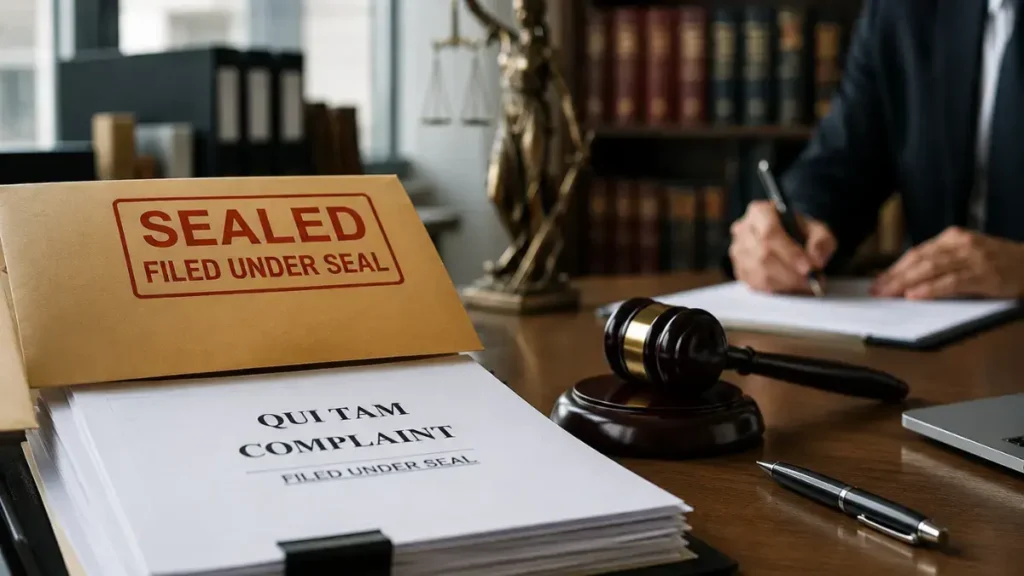
Filing a qui tam lawsuit is not like filing a standard lawsuit. It involves a highly secretive and specific process:
- Filing “Under Seal”: When your attorney files the lawsuit, it is completely hidden from the public and the company you are suing. It is filed “under seal.” This secrecy gives hides your identity while the government investigates the allegations without tipping off the fraudsters.
- The Government Investigation: The Department of Justice (DOJ) will review your evidence. They might subpoena company records, interview witnesses, and dig into the financial trails. This process can take months or even years.
- The Intervention Decision: Once the DOJ finishes its investigation, it makes a choice. If the case is strong, the government will “intervene” (take over the lawsuit). This is what we want, as cases backed by the DOJ are highly successful. If they decline to intervene, you and your attorney can still pursue the lawsuit on your own, though it becomes a much steeper uphill battle.
The Whistleblower’s Reward
Why would anyone take on the stress of a massive federal lawsuit? Aside from doing the right thing for U.S. taxpayers, the FCA offers a major financial incentive.
If the lawsuit is successful—either through a settlement or a trial victory—the government will recover the stolen funds. As a reward for your bravery and your insider information, you are entitled to between 15% and 30% of the total amount recovered.
Because FCA penalties are exceptionally steep (companies often have to pay back three times the amount they stole, plus per-claim fines), these settlements often go into the tens of millions of dollars. A 15% cut of a $10 million recovery can be a life-changing amount of money.
What About Retaliation?

The biggest fear for any whistleblower is losing their livelihood. The creators of the False Claims Act anticipated this.
The FCA includes strict anti-retaliation protections. If your employer fires, demotes, harasses, or discriminates against you because you investigated or filed a qui tam lawsuit, you have the right to sue them for that retaliation. You can seek reinstatement, double back pay, and compensation for any special damages.
The Bottom Line
Blowing the whistle is a courageous act, but it is not a DIY project. The rules surrounding qui tam lawsuits are incredibly strict. For example, you have to be the first to file the claim, and your information cannot simply be pulled from a public news article.
If you suspect your employer is defrauding the federal government, the best first step is to quietly and confidentially consult with an experienced whistleblower attorney. They can help you evaluate your evidence, protect your identity, and ensure you navigate the False Claims Act safely and successfully.